New nonstop flights between Philadelphia and Budapest tighten the distance between the US East Coast and Hungary, making the Hungarian capital far more accessible for tourists, business travellers and medical tourists from the Mid‑Atlantic region. For many Americans who once saw Central Europe as a multi‑stop journey, this route turns Budapest into a simple, single‑hop city break or treatment destination.
What’s New About the Philadelphia–Budapest Route?
American Airlines has resumed a direct Budapest–Philadelphia service after a six‑year break, with the flight initially planned as a seasonal operation from May to October. The daily service departs Budapest late morning and reaches Philadelphia in the early afternoon, then returns in the evening to arrive back in Budapest the following morning, creating convenient same‑day connections in both directions.
Visit Hungary’s CEO has described the renewed route as “excellent news” for the tourism sector and business community, emphasising that Philadelphia is one of the airline’s biggest hubs with around 100 onward connections across the United States. In practice, this means travellers from much of North America—not just the Philadelphia area—gain easier access to Budapest by routing via PHL rather than relying on European hubs such as Frankfurt, London or Zurich.
Shorter Travel Times and a Smoother Journey
Until now, most passengers flying from Philadelphia to Budapest had to connect through airports like Frankfurt, London or Munich, often adding several hours of layover time and some risk of missed connections or lost luggage. Flight comparison tools note that indirect journeys can take 11–14 hours door‑to‑door, depending on schedules and stops.
A nonstop flight cuts that time significantly. Industry commentary around the route suggests that American’s non‑stop service trims roughly 2–5 hours off typical one‑stop itineraries, eliminating the need to change planes mid‑journey. For leisure travellers, that means less fatigue and more time in the city; for business travellers and medical tourists, it simplifies scheduling and reduces the stress associated with tight connections.
Direct services also tend to make prices more predictable. As new capacity comes online, fare competition with European carriers that currently dominate the route—via cities such as Frankfurt or Zurich—can help keep average ticket costs in check. Over time, a stable nonstop option usually encourages more people to book who might previously have considered Central Europe too complicated to reach.
Tourism Benefits: Budapest as a True City‑Break Option
Budapest has already been breaking records, with more than 8.1 million guests visiting the capital in 2025 and around 18.5 million overnight stays. Tourism agencies highlight that foreign arrivals to Hungary overall jumped by about 12 percent in 2025, and Budapest accounts for a large share of this growth.
The Philadelphia–Budapest route strengthens this trend in several ways:
-
It opens a direct door from a major US metropolitan area and its surrounding region to Central Europe.
-
It gives US travellers a fresh alternative to more saturated European gateways, such as London or Paris, for their transatlantic trips.
-
It allows travellers from cities connected to PHL—across the Midwest, South and East Coast—to reach Budapest with a single change in the US rather than in Europe.
Visit Hungary’s leadership explicitly links the route to an expected rise in US visitor numbers, noting that nearly 400,000 American tourists already visit Hungary annually. With a direct link, those numbers can grow, particularly among travellers who prefer straightforward routes and are attracted by Budapest’s blend of architecture, Danube river cruises and wine regions.
Impact on Business Travel and Investment
Philadelphia is one of American Airlines’ largest hubs, with around 100 direct domestic connections and strong links to Canada and Mexico. That network matters for business: executives, entrepreneurs and conference delegates from across North America can now treat Budapest as a more accessible European base.
Business tourism gains from the route in several ways:
-
Corporate links: companies with offices or partners in Central Europe can schedule meetings and site visits with fewer travel complications.
-
Conferences and events: Budapest’s position as an affordable, attractive meeting city is strengthened when organisers can advertise an easy connection from the US East Coast.
-
Trade and investment: easier travel typically encourages more exploratory trips—by investors, educators, and cultural organisations—who might otherwise postpone or skip a visit.
Hungarian tourism officials have pointed out that better air connectivity is a key factor in Budapest’s recent tourism boom, with the airport handling a record 19 million passengers in 2025. Adding a direct transatlantic route from a major US hub clearly fits into that strategy of making the city more competitive against other European capitals.
Medical Tourism: Lower Barriers for US Patients
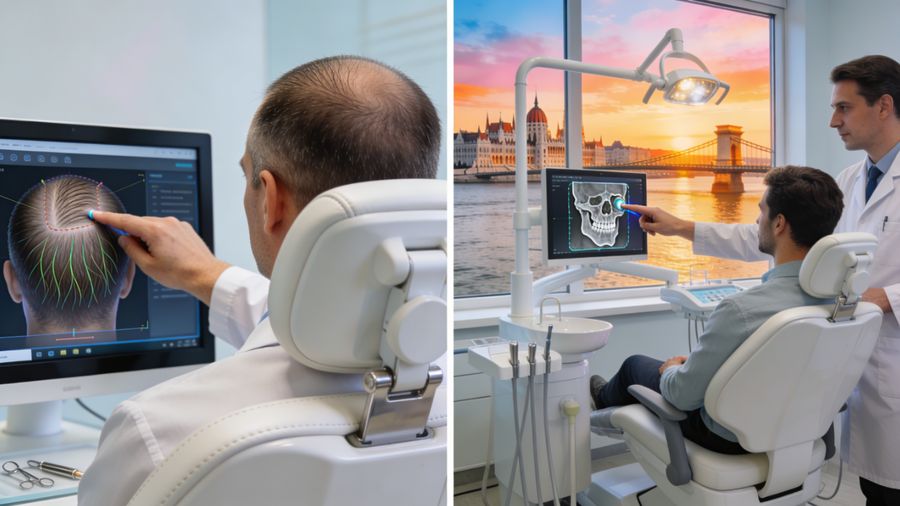
Hungary—and Budapest in particular—is already a recognised player in medical tourism, especially in dental care and cosmetic procedures. Clinics in the capital treat large numbers of European patients seeking implants, full‑arch restorations, aesthetic dentistry, orthodontics, hair transplants and minor cosmetic surgeries at prices often far below those in Western Europe and the US.
The new direct route matters for American patients in three main ways:
-
Shorter, less stressful travel
For someone travelling for dental implants or surgery, every extra hour in transit increases fatigue and stress. Cutting out a European layover means:-
Fewer security checks and boarding procedures.
-
Less risk of delays disrupting carefully scheduled treatment appointments.
-
A smoother journey home when patients may feel sensitive or tired after procedures.
-
-
More predictable planning for complex treatment plans
Many Budapest clinics package accommodation, airport transfers and treatment into organised medical tourism programmes. Having a stable, daily nonstop flight makes it easier to design packages that work around transatlantic arrival times and reduce the chance of missed pre‑op consultations or imaging appointments. -
Stronger appeal for price‑sensitive but quality‑conscious US patients
Medical tourism providers stress that Americans can save a large fraction of typical US costs by combining treatment in Budapest with a short city break. When the route feels as simple as a direct flight to any European capital, more US patients may be willing to consider this option—especially for high‑ticket treatments like full‑mouth rehabilitation, which can cost tens of thousands of dollars more at home.
Given that Budapest already hosts some of Hungary’s best‑known dental and cosmetic clinics, a direct link from Philadelphia effectively extends the catchment area for these services into the broader US market.
Wider Benefits for Hungarian and US Travellers
The route does not only serve Americans heading to Europe; it also benefits Hungarian and regional travellers heading the other way.
-
Hungarian travellers gain direct access to Philadelphia as a cultural and historical city, plus convenient onward flights to more than 100 North American destinations via American’s network.
-
Tour operators can design twin‑centre packages, pairing Budapest with East Coast cities or national parks, using Philadelphia as the gateway.
-
Educational and cultural exchanges between institutions in Hungary and the US East Coast become logistically easier, supporting student mobility and joint projects.
From a tourism policy perspective, Visit Hungary’s CEO has suggested that strong load factors on the PHL–BUD service could encourage the airline to extend it beyond the initial May–October window and potentially inspire other carriers to launch direct flights from additional US cities. That would further embed Hungary on the North American travel map.
How the Route Fits into Budapest’s Tourism Growth Story
Budapest is already one of Europe’s fastest‑growing city destinations. Recent data shows that in 2025, Budapest alone hosted more than 8.1 million guests with around 18.5 million overnight stays, representing double‑digit growth over the previous year. The capital accounts for a significant share of Hungary’s total 20 million visitors, underlining its role as the country’s main gateway.
Air connectivity and tourism growth move together: Budapest Airport handled about 19 million passengers in 2025, its highest volume to date. New long‑haul routes like Philadelphia contribute to:
-
Higher overall passenger numbers and more competition on fares.
-
Better year‑round occupancy for hotels, especially in the 3‑ and 4‑star segments favoured by city‑breakers and medical tourists.
-
Stronger justification for further investment in tourism infrastructure, from hotels and river‑cruise docks to conference venues.
By tying a major US hub directly into this network, the PHL–BUD route becomes a strategic link rather than just another seasonal leisure flight.
What It Means for Travellers from the Philadelphia Region
For travellers living in Philadelphia, New Jersey, Delaware or nearby states, the new route makes Budapest – and wider Hungary – significantly more attractive as a destination. Instead of planning multi‑stop European connections, they can:
-
Book a single nonstop to Budapest for long‑weekend city breaks or week‑long vacations.
-
Combine Budapest with rail trips to Vienna, Prague or Lake Balaton, using the Hungarian capital as a Central European base.
-
Schedule medical treatments in Budapest with the reassurance of a direct return flight home after recovery.
Combined with Hungary’s reputation for good value—where accommodation, dining and entertainment are generally cheaper than in many Western European capitals—the easier access increases Hungary’s competitiveness in the US outbound market.
In practical terms, the new Philadelphia–Budapest nonstop route does more than shorten a line on the map. It reduces friction for US visitors, opens new possibilities for business and investment, and gives Budapest’s medical tourism and hospitality sectors a clearer path into the North American market. As long as passenger numbers stay strong, this single new flight has the potential to reshape how people on both sides of the Atlantic think about travelling between the US East Coast and Central Europe.