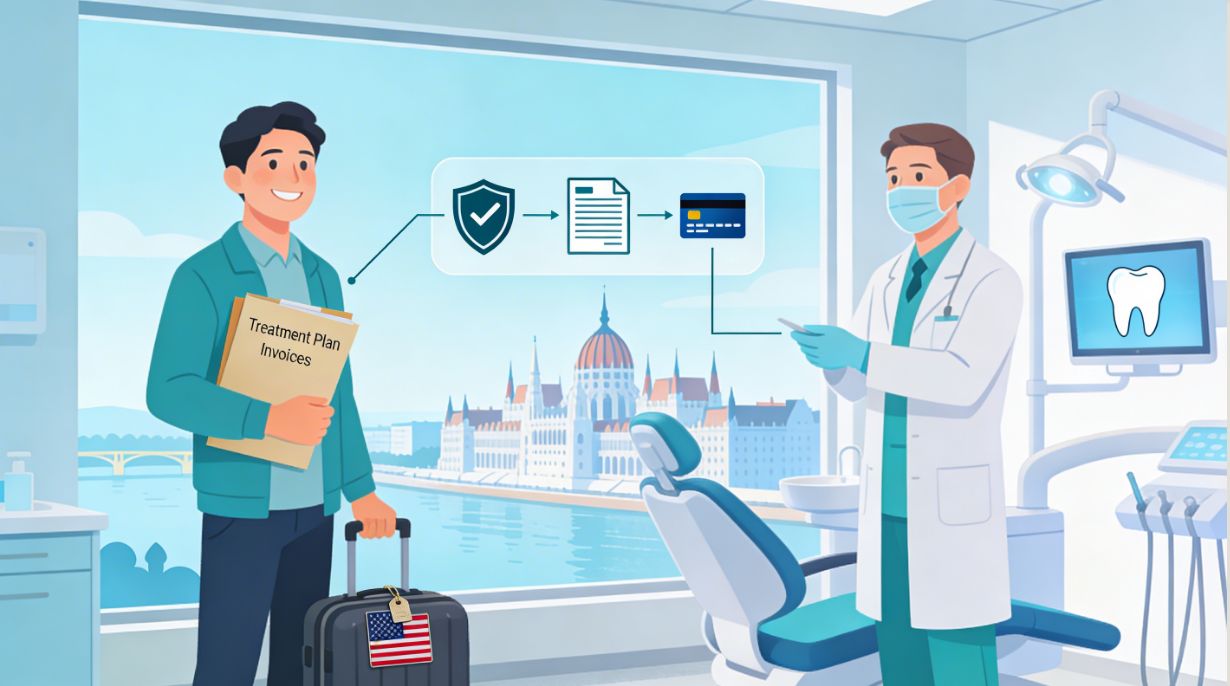
US dental insurance and European public schemes are built around very different systems, so most visitors who come to Hungary for dental work end up paying out of pocket and, at best, chasing partial reimbursement after they return home. Understanding how your American dental plan or European Health Insurance Card fits into this picture can help you plan your budget realistically before you book flights to Budapest or any other Hungarian city.
Does US dental insurance cover treatment in Hungary?
For most Americans, standard dental insurance from big names like Delta Dental, Cigna, Aetna and similar providers is designed for use within the United States and sometimes Canada. Policies are built around preferred provider networks, negotiated fee schedules and billing systems that don’t extend to private clinics in Budapest, Debrecen or other Hungarian cities.
In practical terms, that means routine or elective procedures you schedule in Hungary are usually not covered in the same way as treatment at home. Your insurer may treat any Hungarian clinic as “out of network” or simply outside the scope of the policy. Claims may be processed only as a courtesy, with no guarantee of reimbursement, or rejected outright because the policy excludes foreign care.
A small number of plans include limited international benefits. These are more common in employer‑sponsored packages for federal workers, expatriates or staff in large multinationals. Even there, cover tends to be narrow – often restricted to urgent or medically necessary treatment rather than full mouth restorations or cosmetic upgrades.
Typical coverage limits for US patients
Even when a US insurer is willing to look at a claim from Hungary, several limits usually apply:
-
Treatment is assessed against “usual and customary” US fees. Any percentage reimbursement is calculated on what the procedure would have cost at home, not what you actually paid in Budapest.
-
Annual maximums still apply. If your plan caps benefits at a relatively low annual limit, large courses of treatment abroad can exceed that cap very quickly.
-
Cosmetic and elective work is excluded. Implants, veneers, crowns for cosmetic reasons and full smile makeovers are generally treated as non‑covered services, regardless of where they are done.
-
Emergency‑only clauses can apply. Some policies will only entertain claims when the treatment abroad was urgently needed to relieve pain or prevent serious harm.
Because of these limitations, most US patients travelling to Hungary for dental treatment plan on self‑funding the entire course of care and treat any potential insurance reimbursement as a bonus rather than a core part of the budget.
Exceptions and alternative ways to get some cover
Although standard US dental plans rarely cover planned work abroad, there are a few situations where partial help is possible. These exceptions are worth exploring, especially for higher‑cost treatment plans.
Travel insurance and medical tourism policies
Some travel insurance packages and specialist medical tourism policies include a dental component. This is usually framed around emergencies – broken teeth from an accident, acute infection, sudden severe pain – rather than elective implants, crowns or orthodontic work. The policy may reimburse you up to a certain limit for emergency care received in Hungary, provided you follow claim procedures and submit detailed receipts.
If you intend to rely on travel insurance for any dental help, read the wording carefully. Look for terms like “emergency dental treatment to relieve sudden pain” and check maximums, exclusions and documentation requirements. Many travellers find that these benefits are designed to cover a basic emergency appointment, not a full treatment plan.
Specialised and international plans
A few types of US‑linked cover are friendlier to treatment outside the country:
-
Plans for federal employees (for example, some FEHB or FEDVIP‑linked products) sometimes advertise worldwide dental benefits.
-
International or expatriate dental policies built for Americans living abroad may include networks of dentists in multiple countries, including parts of Europe.
-
Some group plans offered by large employers with global operations include limited overseas dental benefits for staff on assignment.
These products are niche, and eligibility depends on your employment or residence status. If you think you may have access to such a plan, the only reliable approach is to check your exact policy documents and speak to member services before you schedule treatment.
How Hungarian clinics try to help
Many dental clinics in Budapest and other Hungarian destinations work with patients from the US, the UK and Western Europe every day. To make life easier, they often:
-
Provide detailed, itemised invoices in English.
-
Include procedure descriptions, tooth numbers and dates in a way that roughly lines up with what US insurers expect.
-
Supply supporting documents such as X‑rays, treatment plans and letters of medical necessity on request.
This documentation doesn’t guarantee reimbursement, but it can significantly improve your chances if your insurer is open to reviewing international claims. It also gives you clear records for your own files, which is important when you are investing in major work like implants or full arch restorations.
Getting pre‑approval or pre‑determination for treatment abroad
If you want to give yourself the best possible chance of receiving some reimbursement from a US insurer for dental treatment in Hungary, you need to engage your insurer before you travel. While many plans don’t offer formal, binding pre‑approval for foreign care, they often have a process called pre‑determination or benefits estimation.
Key steps before you fly
-
Review your policy in detail
Read your plan booklet or log into your member portal and look specifically for sections on:-
Out‑of‑network benefits.
-
Coverage outside the US.
-
Emergency versus elective care.
-
Documentation requirements for international claims.
-
-
Contact member services
Call the number on your insurance card and ask targeted questions:-
Does my plan consider dental treatment abroad at all?
-
If so, is it emergencies only, or can planned procedures be reimbursed?
-
Are there caps based on US “usual and customary” fees?
-
What documentation is required from a foreign dentist?
-
-
Request a pre‑determination
Many insurers will review a proposed treatment plan and give you a written estimate of any benefits they might pay. To do this, you usually need:-
A detailed treatment plan from the Hungarian clinic (in English).
-
Procedure descriptions and codes where possible.
-
Tooth numbers and surfaces involved.
-
Estimated dates and costs.
The insurer will then issue a non‑binding estimate. It is not a guarantee of payment, but it gives you a clearer picture of what might be reimbursed.
-
-
Clarify payment expectations
Hungarian clinics almost always expect payment in full at the time of treatment, often in instalments as each stage is completed. Make sure you understand:-
Total expected cost in local currency and in your home currency.
-
Which payment methods are accepted (card, bank transfer, cash).
-
Timing of payments relative to each visit.
-
Documentation to collect in Hungary
Because most international claims are processed on a reimbursement basis, your paperwork is critical. Ask your clinic to provide:
-
Itemised invoices with each procedure listed separately.
-
Dentist and clinic details, including tax number and contact information.
-
Dates of service and tooth numbers for each item.
-
Copies of X‑rays and scans where relevant.
-
A letter explaining why the treatment was medically necessary, if your insurer places weight on that distinction.
Once you are home, submit everything promptly through your insurer’s preferred channel and keep copies of all documents. International claims often take longer to process, and missing details are a common reason for delays or denials.
Which US dental insurers are more open to international treatment?
Very few mainstream US dental insurers actively promote coverage for planned treatment overseas, but there are some patterns worth noting when you are comparing options or trying to understand your existing plan.
Plans with broader international scope
Some of the products more likely to have international features include:
-
Federal employee and retiree dental plans that advertise worldwide benefits. These may treat overseas providers similarly to domestic out‑of‑network dentists, subject to the usual annual limits and exclusions.
-
International dental plans designed for people living abroad, often linked to global health insurance products. These provide access to networks in many countries and reimburse in multiple currencies.
-
Certain enhanced options within large insurers’ product ranges that mention “worldwide emergency dental cover” in their brochures.
Even when these features exist, they usually come with conditions: emergency‑only benefit definitions, lower reimbursement percentages outside the network, and requirements for extensive documentation.
Limits of regular commercial plans
Most everyday dental plans sold to US residents through employers or the individual market:
-
Restrict coverage to dentists licensed and practising in the US (and sometimes Canada).
-
Apply strict out‑of‑network rules with lower coverage percentages if they consider any foreign claims at all.
-
Exclude major restorative and cosmetic work abroad, even if a similar procedure might be partly covered at home.
If you hold one of these plans, it is safest to assume that your dental tourism trip to Hungary will be self‑funded, and treat any reimbursement as a pleasant surprise rather than a core part of your financial plan.
Why US insurers often deny claims from abroad
Understanding why claims are denied can help you avoid simple mistakes and decide whether pursuing reimbursement is worth the effort. Common reasons include:
-
Policy exclusions for foreign care – the plan wording clearly states that treatment outside the US is not covered, or is limited to emergencies under very narrow definitions.
-
Elective or cosmetic classification – implants, veneers, whitening and aesthetic crown work are frequently labelled as non‑essential, and therefore non‑covered.
-
Insufficient documentation – invoices that are not itemised, lack tooth numbers or dates, or are not translated into English may be rejected outright.
-
Missing pre‑authorization where required – some plans insist on pre‑authorization for major work, even domestically; if you skip this step abroad, the claim may fail regardless of clinical merit.
-
Late filing – insurers often impose a strict time window (for example, 90 or 180 days from the date of service). Crossing that deadline can make the claim ineligible.
-
Coding and administrative errors – mismatched patient details, incomplete dentist information or codes that don’t align with the insurer’s system can all lead to denial.
If a claim is denied but you believe there is a genuine case for reimbursement, you can typically file an appeal. This involves reviewing the explanation of benefits, gathering supporting evidence from your Hungarian dentist and supplying a clear, well‑structured letter explaining why the decision should be reconsidered.
What the European Health Insurance Card covers in Hungary
While US dental insurance and travel policies focus on private arrangements, the European Health Insurance Card (EHIC) is part of the EU’s public healthcare cooperation. It applies to EU/EEA citizens and some Swiss residents visiting other member states, including Hungary.
EHIC allows holders to access medically necessary treatment in public or contracted facilities during a temporary stay, at the same cost as locals. In Hungary, this means care delivered through providers contracted with NEAK, the National Health Insurance Fund.
Dental care under EHIC
Dental coverage through EHIC in Hungary is limited and focused on essential treatment. Depending on your age, status and the specific clinic, it can include:
-
Emergency dental care to relieve acute pain or treat infections.
-
Tooth‑preserving procedures such as fillings when clinically necessary.
-
Certain forms of dental surgery.
-
Treatment for gum disease where failure to treat would compromise health.
Some groups, such as pregnant women, new mothers within a defined period after childbirth and certain age groups, may be entitled to a broader range of state‑funded dental care in public settings, though charges for materials often still apply.
Cosmetic, elective or purely aesthetic treatments are not covered by EHIC. If you come to Hungary for veneers, implants, full smile design or orthodontics, you should expect to pay privately, even if you hold a valid card from your home country.
Practical use of EHIC in Hungary
If you are an EU/EEA citizen relying on EHIC for dental care during a stay in Hungary:
-
Confirm that the dentist or clinic you plan to visit is contracted with NEAK; private clinics may not be part of the public system.
-
Present your card and photo ID at the point of registration.
-
Be prepared for co‑payments or charges for materials, even if the core service is covered.
-
Keep receipts and documentation in case you need to clarify charges with your home insurer later.
EHIC is designed as a safety net for necessary care while travelling, not as a funding mechanism for dental tourism. For planned, higher‑value treatment, private payment remains the norm.
Planning your Hungarian dental trip with realistic expectations
Whether you are travelling from the United States, elsewhere in Europe or another region, Hungary’s reputation for skilled dentists and more affordable prices can make it an attractive option. However, the insurance landscape rarely allows you to shift the entire cost onto your existing dental plan or public scheme.
A practical approach is to:
-
Treat your Hungarian treatment plan as primarily self‑funded.
-
Investigate any possible emergency or partial benefits in your existing insurance, but assume they may be limited.
-
Obtain detailed written treatment plans and invoices in English.
-
Keep careful records and file any claims or appeals promptly.
With clear expectations and good documentation, you can enjoy the advantages of Hungarian dental care—often lower prices, modern clinics and experienced dentists—without being caught off guard by insurance limitations that only become apparent after the work is done.